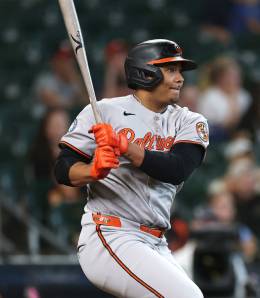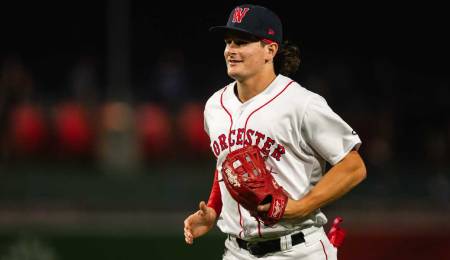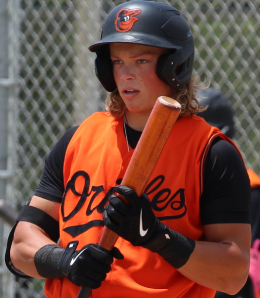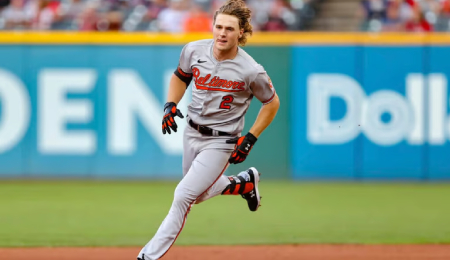
You’ve got to be impressed with the turnaround the Baltimore Orioles’ organization has undergone in the last year. After failing to win even 70 games last season, the O’s are playing better than .500 ball through the first three months of the season, with homegrown talent playing a vital role in the resurgence.
Anchored by organization-developed stars like Brian Roberts, Nick Markakis, Daniel Cabrera and Garrett Olson, a system that was in total disarray very recently is now at very least mediocre, and improving rapidly. The last three drafts have proved much more fruitful for the O’s, something that will stead this team well as it looks to make hay in the tough AL East in the coming years.
Let’s examine some of the future Orioles we’ll be hearing more about soon:
Colin Allen, a 21-year-old righty the O’s selected in the 22nd round last year, has been almost untouchable so far this season with the Rookie-level Bluefield Orioles. Armed with a go-to curveball and a 91 mph fastball, the converted outfielder has struck out 15 batters in a team-high 13 1/3 IP, limiting opponents to a BA under .175. Allen credits Bluefield pitching coach Troy Mattes with instilling in him the idea that pitchers shouldn’t give hitters too much credit – a concept that’s stead the youngster very well as he puts himself on the map as a prospect.
Lance West, a 39th round pick in last month’s draft, is proving to be a real great late-round steal so far, seamlessly making the transition to the pro game. The 20-year-old is hitting for power (four homers, .730 SLG), average (almost .300) and is showing on-base skills (with an OBP of almost .425). Coming off back-to-back multi-hit games, West is on a tear and may be a candidate to move to Class-A before season’s end.
Catcher Wally Crancer, a 12th round pick in 2007, has made great strides offensively this season. Through 45 games at Class-A Delmarva, he’s batting .296 with four homers and 16 walks. He’s been converted from the outfield to help advance his career, and so far, it has not affected his offense, a very common occurance when a player is shifted, especially behind the plate. Crancer has also played some left and right field, DH and even first base, so the team is doing whatever it takes to keep the soon to be 24-year-old’s bat in the lineup. He’ll need to move quickly to have a chance to become a prospect.
I love what I’m seeing out of Zach Britton, a third round pick in 2006. The 6’2” lefty has handled the move up to Delmarva with ease this season, going 7-5 with an excellent 2.85 ERA through 16 starts. He’s yielded just 76 hits and 25 walks in 88 1/3 IP, fanning 64. Just 20 years old, this is a kid that needs to be watched.
Jake Arrieta, the O’s fifth rounder last year, is performing quite admirably in his professional debut for the Class-A Frederick Keys. Despite some recent struggles, the 22-year-old righty is 5-4 with an ERA barely over 3.00 and 91 Ks in 89 2/3 IP. He’s allowed just 64 hits. At one time, Arrieta was expected to go in the top 20 picks of the draft, but he slipped all the way to the fifth round when he pitched very inconsistently in the month leading up to the draft. He could prove to be a serious steal, and is someone to watch in keeper leagues.
Matt Wieters, the fifth overall pick last year, signed too late to make his pro debut in 2007, but man, is he ever living up to the hype this year. The 22-year-old switch hitting catcher dominating High-A ball, batting .345 with 15 homers and 44 walks in 69 games before a recent promotion to Double-A Bowie. Clearly, the higher level is not intimidating Wieters, as he continues to wield a potent bat (.292) with power (one homer and three doubles in 24 at bats) and superior plate discipline (five walks, three strikeouts). Make no mistake: this kid is the real deal, and it wouldn’t shock me if he’s ready to challenge for a starting job in B-More as soon as next spring. In fact, I would be shocked if Wieters isn’t in the majors by this time next year. Expect to see him at the very top of most prospect lists heading into 2009.
David Hernandez, Baltimore’s 16th round pick in 2005, has arrived as a prospect this season after some very middling results his first two pro seasons. The 23-year-old righty has made the jump to Double-A – the toughest leap for a pitcher – look easy. He’s 5-1, 2.63 with 100 strikeouts in 89 innings, while limiting opponents to a .209 BAA. Hernandez has been especially untouchable in his last four starts (seven hits and two earned runs in 24 2/3 IP, showing near no-hit stuff in back-to-back starts), so if he can sharpen his control a smidgeon, we could have a serious prospect on our hands here.
Chris Tillman, Seattle’s second rounder in 2006 who came to the O’s in the Erik Bedard deal, has looked fantastic at Bowie. Just 20, this righty has a very bright future, and the fact that he’s been able to maintain a solid K rate (81 in 79 IP) despite the jump to a higher level at such a young age has me very impressed. Opponents are batting just .214 against Tillman, a name that needs to targeted in keeper leagues.
Outfielder Nolan Reimold, despite solid numbers, has been a bit of a disappointment at Double-A only because in his half-season there in 2007, he was fantastic. Still, he’s coming around of late and definitely looks to have his power mojo back with six dingers, a double and nine RBI in the last five games. If this keeps up, he could find himself at Camden before season’s end.
Major League Baseball held its annual First Year Player draft this week, so let’s take a quick look at the first round results. Many of these names are ones you’re going to be hearing a lot about from a fantasy perspective, some sooner than others. So it’s never too early to familiarize yourself with them, especially in keeper leagues.
1. Tampa Bay Rays – Timothy Beckham, SS, Griffin HS (Georgia): This five-tool player was atop pretty much every pre-draft list, so this selection shocked exactly no one. As if the Rays didn’t have enough young talent already, within two or three years, this 18-year-old will be manning shortstop for this team. Beckham is a superb athlete who was the clear cut best available high school player this year.
2. Pittsburgh Pirates – Pedro Alvarez, 3B, Vanderbilt U.: Alvarez is another good athlete, and his bat is his best tool. From a very young age, this kid differentiated himself with his powerhouse tendencies. Considered the best third baseman in college ball, Alvarez is a good runner, and described by his coach as a real leader. The 21-year-old New York native was drafted by Boston in the 14th round in 2005 out of high school. Obviously, opting for college did him and his draft status wonders.
3. Kansas City Royals – Eric Hosmer, 1B, American Heritage School (Florida): This guy’s got some serious pop, even to the opposite field, and small wonder with a 6’4”, 215-pound frame that still has filling out to do at his tender age of 18. He’s blessed with a very natural left-handed swing that will probably require very little tinkering, so Hosmer has a chance to move through the Royals’ system quickly. He’s been lauded for owning a very advanced bat for a high school player.
4. Baltimore Orioles – Brian Matusz, LHP, U of San Diego: This 21-year-old southpaw, the first pitcher taken in the draft, has long been a fixture on the various pre-season college award watch lists. He’s reached 94 mph, but tends to comfortably pitch in the high 80s, low 90s. Matusz’s delivery seems fairly low-effort, so he should maintain the good health he’s experienced up until now. Matusz was a big-time high school prospect, but because of his salary demands, he slipped until the fourth round when he was first drafted, opting to go to USD when negotiations broke down with the Angels.
5. San Francisco Giants – Gerald Posey, C, Florida St. U: More commonly known as “Buster,” Posey is an All-American who has a chance to become the Giants’ starting catcher in the not-too-distant future. Certainly, there’s plenty of opportunity in this organization, still fairly barren, although on the rebound after years of being unable to produce position players. The 21-year-old not only can hit, but he has a chance to stay behind the plate, and that’s a rare commodity.
6. Florida Marlins – Kyle Skipworth, C, Patriot HS (California): The Giants started a mini run on catchers here, with the Marlins grabbing the first high school backstop in Skipworth. This continues a trend for Florida of selecting power hitting high school prospects in the first round, something the team also did last season. This 18-year-old has a nice line-drive stroke from the left side of the plate. Skipworth will face what most young catchers – especially from the high school ranks – have to deal with, specifically, questions about his ability to hit enough while also remaining behind the plate. However, Skipworth really opened eyes at the prospect showcases in the last year, soaring up the rankings in the process. At one point this season, he set a new state record with 18 consecutive hits, reaching base in 25 straight plate appearances along the way. I guess that’ll do.
7. Cincinnati Reds – Yonder Alonso, 1B, U of Miami: Alonso arrived in the U.S. from Cuba at the age of seven. Now 21, he’s coming off a season with the Hurricanes in which he was a Louisville Slugger Pre-season Second Team All-American, bagging a couple ACC Player of the Week Awards along the way. Alonso has good bloodlines, as his father was a professional catcher and first baseman in Cuba. He’s adept at driving the ball the other way, and projects as a tremendous run producer.
8. Chicago White Sox – James Beckham, SS, U of Georgia: The second Beckham taken (no relation) is also a middle infielder, an area the Sox have lacked depth at for some time. The A’s were said to be after him, hoping to convert Beckham into a second baseman, something that’s likely to happen to him in any organization. Apparently, he isn’t the type of prospect that will jump out at you at first blush, but he does a lot of things well, including hitting with some surprising power.
9. Washington Nationals – Aaron Crow, RHP, U of Missouri Columbia: This 21-year-old righty was another pre-season All-American. Crow first gained national attention by being named the top prospect of the Cape Code Summer League in 2007. Some have questioned how durable he’ll be as a pro, but he set a Missouri school record for starts in a season in 2007. Crow is able to crank it up to 96 mph – fast enough to become the first righty taken off the draft board this year.
10. Houston Astros – Jason Castro, C, Stanford: Castro, not to be confused with the American Idol contestant, believes he’ll sign with the Astros shortly after Stanford’s season ends, and you’ve got to believe Houston will be motivated to get his name on the dotted line after failing to sign its top pick last year. The third catcher taken in the top ten picks, Castro is enjoying a breakout year for the Cardinal, leading the team in hitting. Last month, he was named a semifinalist for the 2008 Coleman Company-Johnny Bench Award, given to the top collegiate catcher in the game. Houston surprised some by grabbing Castro this soon, especially considering he has shown himself to be vulnerable to change-ups.
11. Texas Rangers – Justin Smoak, 1B, U of South Carolina: The Rangers have done a great job restocking their farm system with recent trades. The selection of Smoak continues that process. Another pre-season All-American, Smoak was considered the third best college prospect heading into the season, but he slipped in the rankings. Regardless, Texas may have landed itself a steal in this 21-year-old, who was the 2006 Cade Cod League MVP. He certainly excited plenty of Gamecock fans with his power. Lauded for his swing mechanics, Smoak is a powerful switch-hitter in the Mark Teixeira/Chipper Jones mold. For the Rangers, it’s the ideal acquisition after they dealt away Teixeira last season.
12. Oakland A’s – Jemile Weeks, 2B, U of Miami: Like many first rounders, Weeks was a pre-season All-American. The 21-year-old is the younger brother of Rickie, currently manning second for the Brew Crew. A prototypical lead-off man, Weeks will add a dimension to the A’s they aren’t exactly known for in recent years – blazing speed. Here’s a closer look at the kid, who gained great big game experience in this year’s College World Series. The second of three Hurricanes to hear their name called in the first round, Weeks was originally selected by Milwaukee in the eighth round of the 2005 draft. But just like it did for his older brother, going to college really helped improve Jemile’s draft stock.
13. St. Louis Cardinals – Brett Wallace, 3B, Arizona St. U: The Cards were very intrigued with the bat this 21-year-old wields. The 2007 Pac 10 Player of the Year (and Triple Crown winner), Wallace is considered among the best hitters in college ball, known for his fantastic patience. Originally drafted in the 42nd round by the Jays in 2005, Wallace opted to go to college instead as he always wanted to be a Sun Devil. Smart call, as he’s now among the top power prospects in the game. He projects as a first baseman as a pro.
14. Minnesota Twins – Aaron Hicks, OF, Woodrow Wilson HS (California): This 18-year-old is considered a premium athlete and was lauded as the best two-way star in his draft class. His future is as an outfielder, however, not on the mound. Hicks was a run machine this year, scoring 50 times in just 34 games. He’s quite small right now, but some think he projects to have five-tool potential because of his incredible athleticism. For a high school player, this pick is a tremendously safe one for the Twinkies.
15. Los Angeles Dodgers – Ethan Martin, RHP, Stephens County School (Georgia): Martin, who turned 19 Friday, is all about power. He has a fantastic arm and can smack the hell out of the ball at the plate. Originally considered a two-way possibility, Martin’s maturation on the mound has dictated that his future will be as a pitcher. He was reaching 95 mph over a year ago, and has been clocked up to 96 more recently. Martin has the athleticism and confidence to rise quickly through a Dodgers system known for developing high school pitchers.
16. Milwaukee Brewers – Brett Lawrie, C, Brookswood SS (British Columbia): The fourth catcher taken in the first 16 picks – sensing a trend yet? – was the first Canadian taken off the board. Catcher is a position the Brewers have struggled to find consistent offense from for many years. Jason Kendall is obviously on his way out, and backup Mike Rivera, at 31, isn’t much younger. The team does have a couple of catching prospects in the pipeline, but Lawrie immediately takes the mantle as the catcher of the future. The highest Canadian position player taken in the draft since 1985, Lawrie could be part of the nation’s baseball entry at the Olympics this summer. This 18-year-old has strong hands and was the MVP of the Canadian National Junior Team, attracting plenty of media attention for his efforts.
17. Toronto Blue Jays – David Cooper, 1B, UC Berkeley: The Jays were said to be interested in Lawrie, but once he was taken off the board, they opted for the best available player remaining on their list in Cooper. The 2007 All-Pac 10 selection also took home the California Student-Athlete of the Week honour on March 31 of this year. Not only did he lead the Bears in home runs, but he also paced the team in walks – a very nice combination of power and patience. Cooper is known for his quiet and easy left-handed swing, but he’s capable of making plenty of noise on the stat sheet. His advanced bat is exactly what this team needs as it struggles on offense. Cooper should be able to move very quickly — the sooner, the better as far as Toronto is concerned.
18. New York Mets – Isaac Davis, 1B, Arizona St. U: Isaac Davis, the son of former Yankee pitcher Ron Davis, became the fifth first baseman taken. Adding a blue chip prospect like Davis is huge for the Mets, who have dealt away much of their system depth in recent years. Tampa Bay picked this now 21-year-old in the 19th round in 2005, but like many youngsters taken out of high school, opting for college was a wise move for Davis. He is projected to be able to hit for more power as he matures.
19. Chicago Cubs – Andrew Cashner, RHP, Texas Christian U: For the second straight season, the Cubs selected this 6’6” right-handed hurler. Last year, they took him in the 29th round, but he opted to head back to college. The year before, the Rox picked him in the 18th round. Apparently, the Cubs don’t believe signing the 21-year-old this time around will be problematic. The reliever has come a long way in the past year, upping his velocity to the 97-98 mph range, so surely the Cubbies will be falling over themselves to get Cashner’s John Hancock on a contract. College closers have made it to the majors very quickly in recent years, with mixed results. The Cubs seem content with Kerry Wood at closer for the time being, and have Carlos Marmol at the ready should he be needed when Wood breaks down again, so there’s no reason to rush Cashner. Of course, they have to sign him first.
20. Seattle Mariners – Joshua Fields, RHP, U of Georgia: Let the run on college closers begin! Taken by the Braves in the second round last year, Fields, who had a sos-so junior season, opted to head back for his senior season. Of course, the fact that he was represented by Scott Boras and negotiations didn’t go his way didn’t help matters. Now, Fields says he hopes to be in the majors by 2009. Here’s a look at him.
21. Detroit Tigers – Ryan Perry, RHP, U of Arizona: Perry, who can bring it at up to 100 mph, marks yet another college reliever plucked in this first round. This 6’4” 21-year-old has decent sink on his fastball when he keeps it down. Perry’s classic delivery allows him to generate serious heat. The selection of Perry continues Detroit’s trend of taking pitching in the opening round – this is the fifth time in the past six years the Tigers have taken an arm over a bat to start the draft. There’s still some debate about whether Perry will wind up as a reliever or possibly a top starter. The former option would be a quicker way to get him to the Show, but if Detroit opts to make him a starter, it will take some time before it sees the fruit of that labour.
22. New York Mets – David Havens, SS, U of South Carolina Columbia: Havens, 21, has shown nice improvement at the plate thanks to his patient approach. He doesn’t project as a serious power threat, but with his bat speed, he should be a modest source of double-digit dingers. Unfortunately, he doesn’t even rank out as an average runner, speed-wise, so don’t be looking to Havens as a source of steals. Boston almost grabbed this kid as a first-rounder three years ago when he was a very productive high school prospect, but even if the Sox had wanted him again, he was long gone by the time they picked at No. 30. The fact that the Mets, with their second first round pick, grabbed him this early is a surprise, especially given that Havens is projected to have to move to third, a position the Mets have sewn up pretty nicely these days.
23. San Diego Padres – Allan Dykstra, 1B, Wake Forest U: Dykstra, who turned 21 last month, is a powerful behemoth, standing 6’5” and weighing 240. He’s an advanced hitter who was among the top power bats in college baseball this year. That the Padres – desperately in need of pop – picked him wasn’t a shock. Except, of course, for the fact that they already have a pretty darned good young first baseman in Adrian Gonzalez. And don’t think for a second that Dykstra – the sixth first baseman taken in the opening round – is capable of handling another defensive assignment with his size, unless it’s with an AL team as a DH, of course. Oh, and by the way, in case you were wondering: he is not related to Lenny, despite the relative scarcity of that surname.
24. Philadelphia Phillies – Anthony Hewitt, SS, Salisbury School (New York): This Brooklyn native hit .496 for his undefeated high school team this season. Check out his sweet right-handed swing, lauded for becoming much cleaner and more efficient this season, here. The 19-year-old, expected to develop power as he matures, is currently blocked by Jimmy Rollins, but he’s got plenty of development time ahead of him either way, so I’m not immediately worried by that. I’m a bit surprised the Phils didn’t grab someone a bit more major-league ready, given their paucity of top prospects at higher levels, but Hewitt has some tremendous upside.
25. Colorado Rockies – Christian Friedrich, LHP, Eastern Kentucky U: This 6’3” southpaw, despite some control problems in 2007, was on the Brooks Wallace Player of the Year Award watch list this season. I’m not overly worried about the walks, as long as he can continue to chalk up the Ks as he did in college (307 in 232 IP, including summer league play). Last summer, thanks to his tremendous curveball, Friedrich ranked fourth among Cape Cod League prospects.
26. Arizona Diamondbacks – Daniel Schlereth, LHP, U of Arizona: Schlereth, a 6’1” southpaw, is yet another college closer, one who set the Arizona record for saves in a season by a freshman back in 2006. He comes from a sports family (father Mark won three Super Bowl rings with the Broncos and Redskins). Daniel, who turned 22 last month, has been clocked as high as 97 mph with his fastball, which is complimented by a strong curve. Confidence isn’t his weakness; Schlereth thinks he can be in the majors by September; a lofty goal considering his college season hasn’t even ended yet.
27. Minnesota Twins – Carlos Gutierrez, RHP, U of Miami: Another trend has definitely emerged here with the Twins taking college closer Gutierrez, who returned this season from Tommy John surgery, a procedure that caused him to be redshirted in 2007. The third of a school-record three Miami players taken in the first round, Gutierrez was a surprise pick in this high a slot given his lack of a secondary pitch. He can bring the heat with his fastball, but doesn’t really have a second go-to pitch, and even as a reliever that’s a stretch. You certainly can’t argue with his college results, however; Gutierrez’s command at Miami was impeccable.
28. New York Yankees – Gerrit Cole, RHP, Orange Lutheran HS (California): This 17-year-old is gifted with an ideal pitcher’s frame (6’3”, 190) and an arm capable of reaching as high as 98 mph, but with a comfort zone in the 92 to 94 mph range. He has a commitment to UCLA, but given that he’s a lifetime Yankee fan, convincing him to turn pro shouldn’t be took difficult (assuming the right amount of zeros are tossed his way). Cole is considered the top right-handed pitching prospect to come out of Southern California since Phil Hughes. And now the Yankees have both of them as they continue to add young arms to the organization.
29. Cleveland Indians – Lonnie Chisenhall, SS, Pitt CC: Chisenhall comes with baggage, having been sent packing from the University of South Carolina after burglary/grand larceny charges last year. He was a high profile recruit for the Gamecocks, so the story made big news. Chisenhall wound up pleading guilty and getting six months of probation. Of course, this isn’t the first time Cleveland has brought in a player with a history. Remember Kaz Tadano and the gay porn scandal? At any rate, Chisenhall isn’t likely to stay at short, projecting at a third baseman as a pro. Let’s hope he sticks to stealing bases from this point on.
30. Boston Red Sox – Casey Kelly, SS, Sarasota HS (Florida): The son of former major leaguer Pat Kelly, Casey Kelly is a hell of an athlete, not only starring as a two-way talent in baseball, but also being a good enough quarterback to be ranked as the 31st best QB prospect by ESPN. Even as a junior at high school, the scouts were already drooling over Kelly. He enjoyed a productive senior year at the plate, and on the mound was dominating. It’s going to cost some bucks to lure him away from a football career, but assuming the Sox can do so, it will be interesting to see if they plan to use him as a shortstop or a pitcher. You can see him hit and pitch here.
Despite an HGH scandal, Jordan Schafer ranks second among our top 35 prospects.
Spikes Up, our exclusive baseball column, is pleased to unveil the fourth annual Spikes Up Top 35 Prospects List, once again beefed up from last year’s version.
This season, 11 players are back from the 2007 rankings, while another 15 (exactly half of last year’s list) have graduated to the major leagues. For the second straight year, just four slipped out of the rankings.
1. Jay Bruce, OF, Cincinnati – After placing 14th in our rankings last year, this tender-aged (just turned 21) flyhawk has shot to the top of the RotoRob Prospect List this year. Bruce is ticketed for a bit of seasoning at Triple-A, but don’t sleep on this guy. Expect him to arrive in Cincy by May or June and be capable of putting up some very strong numbers immediately. Sure, he’ll probably be prone to plenty of Ks, but Bruce is a star in the making, drawing comparisons to Larry Walker and Jeremy Hermida, among others. The only thing worrying me here is manager Dusty Baker’s propensity to screw up younger players.
2. Jordan Schafer, OF, Atlanta – There’s some debate whether Schafer is the top Braves’ prospect or even the best of the three great young outfield prospects in the organization (Schafer, Jason Heyward, Brandon Jones), but for my money, Schafer is the man. He’s the clear heir apparent to fill the void left in centrefield when Andruw Jones left town. Sure, Schafer is getting hyped by the Atlanta PR machine, but this 21-year-old, a third-round pick in 2005, is headed for greatness. Last season, he completely destroyed the Sally League, forcing an early-season promotion to High-A where he scored 70 runs in 106 games, showed some pop and some patience. Yes, I’d like to see him cut the strikeouts, and the HGH suspension will definitely delay in his arrival date, but it wouldn’t shock me if Schafer were starting in Atlanta by mid-season 2009, if not sooner.
3. Clay Buchholz, RHP, Boston — Although he struggled this spring, don’t let the bloated ERA fool you — Buchholz is among the top prospects in the game. He absolutely dominated in Double-A last season, earning recognition as a classification All-Star from Baseball America, before moving up to Triple-A. With Pawtucket, Buchholz had some issues with the long ball, but certainly held his own. Finally, he pitched extremely well with the BoSox (perhaps you heard a thing or two about that no-hitter?).
4. Evan Longoria, 3B, Tampa Bay – This power-hitting hot corner prospect enjoyed a big season as a Biscuit (mmm…biscuits) before moving up to Triple-A and continuing his power display. Our No. 20 prospect last year, the kid’s time has come, but the Rays decided to have him start at Triple-A even though he deserved to break camp with a job after such an impressive spring. Regardless, Longoria will definitely factor into the AL ROY race this season, especially now that he’s arrived in Tampa thanks to an injury to Willy Aybar.
T-5. Wade Davis, RHP, Tampa Bay – Davis soared up the prospect list in 2007, moving up to High-A and significantly improving his control without sacrificing the Ks. He then moved up and more than held his own at Double-A – one of the true acid tests for pitching prospects. Davis is starting the year back in Double-A, but I’m confident he’ll see time in the majors this year, making him an intriguing reserve pick. This 22-year-old is part of a treasure chest of talent that the Rays have hoarded, and is proof positive (along with Jake McGee and David Price) that the organization is finally capable of developing pitching prospects (although James Shields’ emergence last year helped begin that process).
T-5. Clayton Kershaw, LHP, Los Angeles Dodgers – Kershaw (our No. 24 prospect a year ago) just turned 20, so ideally the Dodgers will find a way to get him more seasoning, but with his dominance, they won’t be able to hold him back for long. LA’s top draft choice in 2006 (seventh overall), Kershaw has been dominant as a pro from day one, taking his place today as the team’s top prospect. Within three months, he’ll be in a Dodger uniform; within three years, he’ll be challenging for the Cy Young award.
T-7. Travis Snider, OF, Toronto — Snider is not expected to be a factor in the majors this year, but in keeper leagues, this is a guy you definitely want to tuck away. While there are some varying opinions of how good a prospect he’ll be, he impressed the hell out of most as one of the youngest players in the AFL last year. Snider, the 14th overall pick in 2006 after a dominating high school season in which he led his team to the Washington State championships, projects as a big-time power hitter down the road.
T-7. Colby Rasmus, OF, St. Louis – This 21-year-old centrefielder has left a wake of damage wherever he’s played. He led his team to the 1999 Little League World Series, and then in high school he mashed 24 homers, passing Bo Jackson for the second highest total in one season by an Alabama High School player. Last season, Rasmus led all Double-A players with 29 homers and looked solid in the AFL, convincing the Cards to clear the decks in CF by dealing veteran Jim Edmonds. St. Louis has opted to let this five-tool talent get a bit more seasoning in Triple-A, but rest assured, he’s going to be patrolling centre in Busch sooner rather than later. Don’t sleep on this kid.
9. Cameron Maybin, OF, Florida – The centrepiece of the package the Marlins received from the Tigers when they dispatched Miguel Cabrera and Dontrelle Willis north to Motown, the not yet 21-year-old Maybin is a future stud in centrefield. As if the Marlins didn’t have enough speed, this kid, potentially the future face of the organization, brings plenty to the table. Size, speed and power – Maybin has it all. Imagine him as the next Torii Hunter, except with a higher ceiling. No wonder Maybin’s already excited fans this spring. After his fast start, however, Maybin fizzled a bit, and will begin the year in Double-A. He’s up slightly from No. 10 on last year’s list.
10. Homer Bailey, RHP, Cincinnati – Despite some souring on him (we had him at No. 4 on the list last year), Bailey still looks like a future ace to me. Just 21, the kid only has 45 career innings under his belt, so I wouldn’t spend more than a buck on him for 2008. But in looking forward, let’s keep things in perspective. Recall that Johan Santana had a 6.49 ERA in 86 innings as a 21-year-old, so don’t panic if Bailey takes some lumps this year. Stay the course, and you’ll be rewarded.
11. Chris Marrero, OF, Washington – He’s only 19, but nothing is going to hold Marrero back for long. The team is expecting big things from their top prospect, and no one’s expectations are higher than Marrero’s – he wants to be in the bigs by the end of the season. I wouldn’t bet against this pure home run hitter arriving in Washington by September, even though he’s starting out at High-A. With a double in his only Spring Training at bat, Marrero already has downtrodden Nats’ fans getting excited.
T-12. Franklin Morales, LHP, Colorado – After enjoying a breakout season in which he was among the Texas League leaders in Ks before a promotion to Triple-A, Morales ultimately wound up in the majors and played a key role over the final two months as the Rox rolled into the playoffs. This 22-year-old lefty has a chance to be the next great Venezuelan pitcher, and he’s a name to watch after breaking camp with the fifth starter job for the Rockies. The team’s top pitching prospect, Morales is gifted with amazing stuff, including a knee-buckling 12-to-6 curve. I’d like to see him sharpen his control, but impressively, it was much less of an issue when he arrived in the majors – a truly excellent sign.
T-12. Andy LaRoche, 3B, Los Angeles Dodgers – After another spectacular half-season at Triple-A, LaRoche made his MLB debut last year, and flashed his gap power. The 24-year-old, the Dodgers’ 39th round pick in 2003, has been riding high since his breakout 2005 season in which he mashed 30 dingers. Adam’s baby bro looked like the odds-on favourite to break camp as the team’s starting third baseman, but a thumb injury will sideline him for five-to-eight weeks. Don’t worry; he’ll be back, and will challenge for the NL ROY before it’s all said and done. LaRoche was our No. 6 prospect a year ago.
14. Jacoby Ellsbury, OF, Boston – Everyone has already seen the impact this kid can have on a team after he took the BoSox by storm late last year and in the playoffs. A great contact hitter, Ellsbury is thought to be the first native Navajo player to ever take the field for a major league team. He’s going to split time in centre with Coco Crisp to begin the season, but Ellsbury’s ability to be an offensive instigator and his superb defensive work will force Crisp out of town sooner rather than later.
T-15. Joba Chamberlain, RHP, New York Yankees – Part of a trio of young Yank hurlers expected to form the nucleus of the pitching staff in years to come, Chamberlain burst on to the scene last season, spending the final two months as Mariano Rivera’s set-up man. This intense hurler gained cult status almost immediately. Ultimately expected to be a starter, that plan’s been put on hold for now as Chamberlain will begin the year out of the pen. But contrary to last season, he will not rely strictly on his fastball/slider combo, instead opting to use all four pitches this year.
T-15. Chase Headley, 3B, San Diego – The Padres’ second round pick in 2005 has ascended through the system and is now the organization’s top prospect. He’s a hard worker, but is currently blocked by Kevin Kouzmanoff. There was talk of either shifting Kouz to left field or converting Headley into an outfielder, but the team believes he’s not ready to play outfield in the majors so they optioned him to Triple-A. He’ll be back, making him a decent late-round flyer in this year’s drafts.
17. Andrew McCutchen, OF, Pittsburgh – The Pirates moved this young speedster up the ladder aggressively last year, and he struggled somewhat at Double-A. But make no mistake – with his power, makeup and strong defense, McCutchen will finally provide the answer the Pirates have been seeking for several years in centrefield very soon. Our No. 17 prospect from last season didn’t hit well in the AFL, but showed a good batting eye. McCutchen will start the year in Triple-A, but should make his MLB before the end of 2008, assuming he can adjust to the higher level as well as he did last year (.313 BA in limited Triple-A action).
T-18. Carlos Gonzalez, OF, Oakland – A key component of the package the A’s received from Arizona for Dan Haren, Gonzalez has emerged as one of the top CF prospects in the game. While there are questions about his attitude, it’s unclear if the 22-year-old Venezuelan is immature or actually has issues. Regardless, he’s a great prospect to tuck away in keeper leagues, although injury issues this spring burned his chances of break camp as the A’s everyday centerfielder. The 2005 Midwest League MVP has all the tools necessary to become a star, and after hitting .310 last season in a brief Triple-A trial, our No. 21 prospect from last year sure looks ready to contribute in the bigs.
T-18. Desmond Jennings, OF, Tampa Bay – As if the Rays needed another top prospect, Jennings burst onto the scene last year after barely being a blip on the Rays’ prospect list heading into 2007. After showing a bit of everything in the Sally League (.315 BA with 45 steals, gap power and patience), Jennings has soared up the charts. This one is strictly for keeper leagues, but if he can duplicate his breakout campaign, this kid will move fast and be knocking on the door of the bigs before you know it.
T-20. Ian Kennedy, RHP, New York Yankees – Another of the young Yankee arms charged with helping to lead the team back to the playoffs for a 14th straight time. This former USC product comes with some health risks, but he’s ascended the New York prospect list for a reason. Some think the Yanks reached a bit when they grabbed Kennedy with the 21st pick in 2006, but with Joba pen-bound, Kennedy landed a rotation spot this season, and judging by his superb spring showing, I’m expecting a solid rookie season.
T-20. David Price, LHP, Tampa Bay – The first overall selection in the 2007 draft was expected to move very quickly, but an injury this spring will slow down that timetable. He’s expected to miss about six weeks and then pitch at High-A, so Price will have to make a serious statement fast if he wants to pitch in the Show this year. He remains a fantastic keeper league prospect, but hoping for a contribution in 2008 now seems a stretch.
22. Angel Villalona, 3B, San Francisco – Could it be true? Could the Giants finally produce fantasy-worthy position prospect for the first time in a generation? Villalona is just 17, so let’s not get too ahead of ourselves, but considering he’ll likely play full-season ball at that age, it’s easy to get excited. A tremendous keeper prospect, Villalona’s long-term home is expected to be first base.
23. Nick Adenhart, RHP, Los Angeles Angels – Despite injuries to the team’s top two starters (John Lackey and Kelvim Escobar), the Halos opted to send their top pitching prospect to Triple-A to begin the season, where he’ll be part of a prospect-heavy Salt Lake squad. Adenhart’s results weren’t awful this spring (although he was a bit too hittable), but the Angels wisely decided to give the youngster more time to mature. After all, he has yet to pitch above Double-A. Keep an eye on Adenhart’s minor league numbers as out No. 22 prospect from last year has sleeper potential as a mid-season call-up.
T-24. Matt Wieters, C, Baltimore – Wieters, the fifth overall pick in last year’s draft, is the best catching prospect in the game. Now, the question is whether he’ll be able to live up to that $6 million bonus the O’s gave him – the biggest upfront payout in draft history. The Georgia Tech alumni and 2006 First Team All-American has the power and on-base skills needed to excel, but as we all know, well-hyped catching prospects often fade into obscurity (A.J. Hinch, anyone?).
T-24. Rick Porcello, RHP, Detroit – Porcello was the fifth highest ranked prospect heading into last year’s draft, but he slipped all the way to No. 27 because of signability issues (the fact that he was a Scott Boras client sure helped). The Tigers grabbed him and signed him to a record $7.28 million, four-year deal, way above bonus guidelines. Immediately, he became the jewel in a Tiger minor league system that is suddenly bereft of top prospects. The 6’5” Porcello was a big New Jersey high school star who was committed to UNC before penning a deal with Detroit. He did not pitch in the minors last year, so is making his pro debut this season at High-A Lakeland.
T-26. Joey Votto, 1B/OF, Cincinnati – Votto’s poor spring cost him the starter’s job in Cincy, but he still made the team and it shouldn’t take much for him to overtake Scott Hatteberg soon. The Toronto-born 23-year-old, drafted out of high school in the second round in 2002, broke through in 2006 as the Southern League MVP. He built on that last year by continuing to show good patience at Triple-A, and did extremely well after getting the late-season call to the Show. This dude is ready.
T-26. Johnny Cueto, RHP, Cincinnati – Much like Nook LaLoosh in Bull Durham, Cueto “announced his presence with authority.” Except, of course, Cueto has an idea where his fastball is going, and it’s usually in the strike zone. This 22-year-old kid from the Dominican Republic was playing in the FSL All-Star game in 2007, but now he’s in the Reds’ rotation and has become an immediate waiver wire favourite. This phenom has No. 1 starter stuff, making him a big part of a revitalized Reds’ system.
28. Neftali Feliz, RHP, Texas – This former top prospect in the Atlanta Braves organization was traded to the Rangers as part of the Mark Teixeira deal at the trading deadline last year. Moving to Class-A ball in Spokane after the deal, Feliz struck out 27 in only 15 innings pitched. Although he’s several years away from arriving in the Show, the kid with the mid-90s fastball has the long term potential to be a top-of-the-rotation starter.
29. Reid Brignac, SS, Tampa Bay – After that 2006 season, when he captured virtually every award available, it was assumed that Brignac would be on the fast track to the bigs. A funny thing happened in that second full season in Montgomery — he proved he was human. With the bar set so high in 2006, a .260 BA, with 17 HR, 81 RBI and 15 stolen bases would have to be considered somewhat disappointing. Expect a better overall performance in 2008 from this 22-year-old former second rounder, our No. 18 prospect from 2007.
30. Mike Moustakas, SS, Kansas City – Drafted second overall in the 2007 draft by the Royals, this 19-year-old shortstop signed for a reported $4 million bonus. Baseball America fingers Moustakas as having the best infield arm, best power and best batting average from the class of ‘07. A graduate of Chatsworth High in California, Moustakas batted .577 with a California prep record 24 homers in 97 at bats. He reported to the Idaho Falls Chukars in the Rookie Pioneer League and batted .293 with ten RBI in 11 games. Because Moustakas is a below average runner, with somewhat limited range, some believe that a change of positions might be in order down the road, but the Royals are planning for now to stick with the “Moose” at his natural position of shortstop.
31. Jarrod Parker, RHP, Arizona – Parker was drafted out of Norwell High in Ossian, Indiana, by the Arizona Diamondbacks with the ninth overall pick in the 2007 draft. The right-handed flamethrower signed just prior to the deadline for a reported $2.1 million bonus. Parker, the 2006-07 Gatorade Indiana Player of the Year, brings to the D-Backs a fastball in the 94-97 mph range, occasionally touching 98 mph. The fact that some scouts suggest he has the best arm action of any pitcher in the 2007 draft bodes well for Parker as he heads into his first full season in professional ball.
32. Jeff Clement, C, Seattle – Coming off a breakout 20-homer, 80-RBI campaign at Tacoma, this former third overall pick from the 2005 draft is looking at a return to Tacoma to commence the 2008 season. With incumbent Kenji Johjima heading into free agency next year, look for 2009 to be the year we see Clement assuming a full-time role. He’s a must-keep in deep dynasty formats.
T-33. Daric Barton, 1B, Oakland – Barton turned a very strong September 2007 into a job this spring at first base. The on-base skills are most certainly evident, although at this time the power seems a bit on the light side for a first baseman. The 22-year-old hit only nine home runs in 516 at bats for Sacramento last year and this apparent lack of power should be a concern heading into 2008.
T-33. Chin-Lung Hu, SS, Los Angeles Dodgers – A well-rounded player, Hu smacked 14 homers and drove in 62 runs with 15 stolen bases last year and has played in both the 2006 and 2007 Futures Games. Despite the fact that it would appear Hu is ready to contribute, with both Rafael Furcal and Jeff Kent signed for 2008, it looks like Hu will be starting the year coming off the bench in LA while he awaits an injury or trade.
35. Brandon Wood, 3B, Los Angeles Angels – It’s hard to believe that our No. 3 prospect from a year ago is still only 23. The memories of that awe-inspiring 2005, when he launched 43 homers and drove in 115 runs, seem like such a long time ago. Wood is starting the year at Triple A and moving back to his original shortstop position. The future still looks bright, but do beware that his K rates from the past three years in the minors are virtually identical. Have we seen the peak here or just a hiccup in the learning curve?
Graduating from last year’s top 30 prospect list: Delmon Young (1), Alex Gordon (2), Philip Hughes (5), Matt Garza (7), Yovanni Gallardo (8), Mike Pelfrey (9), Billy Butler (11), Troy Tulowitzki (13), Ryan Braun (15), Chris Young (16), Tim Lincecum (19), Justin Upton (23), Andrew Miller (26), Jason Hirsh (29), Hunter Pence (30).
Dropping off the list this season: Adam Miller (12), Fernando Martinez (25), Scott Elbert (27), Jose Tabata (28).
Despite stuggling at Double-A, former Tiger farmhand Juan Francia is delivering for the Scranton/Wilkes-Barre Yankees.
In one my 583 daily Google searches, I came across an interesting story about a Yankee farmhand who provided instant dividends after his first ever promotion to Triple-A last weekend.
On Sunday, infielder Juan Francia, called up from Double-A the day before, singled in the winning run for his first Triple-A hit in his first Triple-A start. Not bad for a guy hitting under .180 through 79 at-bats at Double-A.
Originally signed by Detroit in 1998 out of Venezuela, Francia looked like a mid-level prospect with top-of-the-order skills, stealing 53 bases with a .270 BA at the age of 20 in Low-A in 2002. Unfortunately, he stalled out in the Midwest League for three years, severely damaging his chances of ever becoming an everyday big league player.
Francia did break through in 2005 in his first action at High-A, batting .325 with 26 steals in 60 games before earning a promotion to Double-A, where he continued to excel with a .290 BA.
Last season, unfortunately, Francia took a big step backward. And when I say big, I mean Grand Canyon big. Try a 406 OPS at Double-A and a demotion back to High-A. It was looking like it would take some luck for him just to get to Triple-A. And if he did so, it would have to be with another organization after Detroit released him.
Despite switching to the Yankees organization this season, it didn’t look like much else had changed when he got out of the gates at Double-A Trenton with a whopping 419 OPS. But with Triple-A Scranton/Wilkes-Barre in need of a utility infielder, the now 25-year-old Francia got the call. So what happens? All Francia’s done is go 5-for-14 with five RBI, a walk and a steal in his first five games at Triple-A. If this keeps up, he may yet earn himself a cup of coffee in the Show one day.
Still with Scranton/Wilkes-Barre, a much longer-serving Yankee farmhand is still awaiting his first shot at the majors. Outfielder Bronson Sardinha, a sandwich pick (34th overall) in 2001, is still very much in the team’s plans after being added to the 40-man roster in November. He tore through the low levels in the minors, but struggled after arriving at High-A in 2003. Sardinha adjusted and made it to Double-A in 2004, but then stalled out for a while.
However, after a strong debut at Triple-A last year (.286 BA, .365 OBP, six homers), Sardinha’s doing nothing this season to justify the Yanks’ faith in him. A .211 BA, including just a .195 mark against righties by the land-handed hitting Sardinha isn’t exactly going to help him keep his roster spot.
The Hawaii native, brother of minor leagers Dane and Duke, is just 24, so could still wind up as a fourth or fifth outfielder one day. But he’ll need to pick things up offensively. A mini explosion last week of five doubles in four games suggests he’s headed in the right direction, but Sardinha hasn’t done nearly enough yet this season to warrant a September callup.
Finally, there was one other name that jumped out at me on the SWB roster. Former Mariner prospect Jamal Strong, a dominant presence in his early professional days, is still kicking around, now with his fourth organization. The 28-year-old outfielder, a sixth rounder by Seattle in 2000, was an All-Star in 2000 at short-season Everett when he swiped 60 bases in just 75 games to go along with a .314 BA and 790 OPS.
The following season, he was again an all-star — in two leagues. First at Low-A Wisconsin, after scoring 41 runs, stealing 35 bases, drawing 40 walks and hitting better than .350 in 51 games. Strong moved up to High-A San Bernardino and turned in another stellar showing with 74 runs, 47 steals, 51 walks, a .311 BA and .411 OBP in 81 games. The kid looked like a future star.
Strong enjoyed another solid season in 2002 at Double, and continued his success into 2003, making his MLB debut. Unfortunately, injuries starting cropping up that season, and over the years, his speed totals waned dramatically. In 2005, he got another 16 games in the Show in what proved to be his final season in the Seattle organization. Strong hasn’t been back to the majors since. Last year, he split the season between the Triple-A teams of the Cubs and Braves, but his numbers were weak.
Now in the Yanks’ organization, Strong has split the season between Double-A and Triple-A. He remains someone capable of drawing a walk — 30 in 54 games combined for a .405 OBP, but with just two steals in 27 games at Triple-A, he’s no longer a feared man on the basepaths. At this point, Strong’s best hope is to land a fifth outfielder/pinch runner gig, certainly a massive disappointment for a player who looked headed to stardom earlier in his career.
By the way, it was remiss of me not to mention that yesterday’s final post was the 600th entry in the site’s history. We remain two weeks and change from our first birthday for those of you wondering. Alright, now that those housekeeping details are out of the way, let’s get down to business. With the Astros continuing to flounder (now tied for fourth place in the NL Central), it’s time to take a quick peek at some players on their Triple-A squad who may be in line for a look at some point this season.
Mark Saccomanno hasn’t done much in his career to gain notoriety (and no, having the same last name asKramer’s buddy Bob doesn’t qualify), but is enjoying a breakout year in his first season at Triple-A. As a 27-year-old corner infielder originally taken in the 23rd round in 2003, Saccomanno hardly qualifies as a prospect, but with the ‘Stros ranking in the bottom half of the NL in homers and near the bottom in BA, surely someone on the parent organization is taking note of his line (56 games, 190 at-bats, .300 BA, 14 doubles, 11 homers, 39 RBI). If you think Houston is having an emergency with its waning offense, Saccomanno’s OPS (911) seems rather appropriate. After Saccomanno became just the second Round Rock player to slug two homers in a game on Monday, Houston may soon be paying a bit more attention. A recent 14-game hitting streak doesn’t hurt, either. Saccomanno repeated Double-A last year, and, while he managed to hit just .245, he slammed 20 homers and 63 RBI despite missing two months with an injury. Well, he’s already more than halfway to matching those totals already and we still have plenty of ball to play. Saccomanno says his success this year is the result of laying off bad pitches. A Houston native, Saccomanno proved he can perform against the best in the world when he stroked two doubles and a homer in three games as a member of the Italian entry at the 2006 WBC. While he’s done the majority of his damage at home (.361 BA with seven of his 11 dingers), Round Rock is not a hitter-friendly park, so that bodes well for his ability to go yard in major league stadiums.
Infielder Danny Klassen is the only other Express player to hit multiple dingers in a game this season. The 31-year-old Canadian is a true Quad-A player, having amassed 1,154 minor league games in his career with only 85 big league appearances and none at all since 2003. Originally a second rounder of the Brewers way back in 1993, Klassen’s been in the Houston system since 2005, but was out of baseball last year. In 2005, he enjoyed probably his finest Triple-A season ever with a 910 OPS, yet he didn’t get a sniff of the majors. A true shortstop who can also play second and third, Klassen is hitting well again this year with a .310 mark through 44 games, but he’s been out of the lineup since late-May. In 85 career big-league games, he’s put up a .226/.289/.341 line with six dingers. A recent surge by Houston shortstop Adam Everett has jacked his BA up to .230, but his overall offensive game has been in decline for three years now, and he was never really that good at his peak. Obviously, Everett’s defensive prowess is valuable to Houston, but surely Klassen could record a 600 OPS, a mark Everett currently remains shy of.
One struggling Astro the team already divested itself of, Jason Lane, isn’t exactly playing like he’s desperate to get back to the Show. Since his demotion to Triple-A a week and a half ago, Lane is batting just .250 through five games, but he does have seven runs, a homer, four RBI and six walks against just one strikeout. He doubled and scored Monday in his first game at home since Houston farmed him out to make room for Chris Burke. During his time with the big club, Lane had the dubious distinction of being perhaps the least productive outfielder in the major leagues. In 36 games and 79 at-bats, he scored just five runs, which is even worse considering he had four homers. Lane drove in 10 runs and hit .165/.175/.354. He’s batting cleanup for Round Rock, so perhaps the 30-year-old — a sixth round pick in 1999 — will put up impressive enough numbers to get another look. Recall that Lane is capable of getting hot and producing, batting .305 with an 890 OPS in the second half in 2005. If he has another big half in him, the struggling Astros’ attack could sure use it now.